February 2, 2020
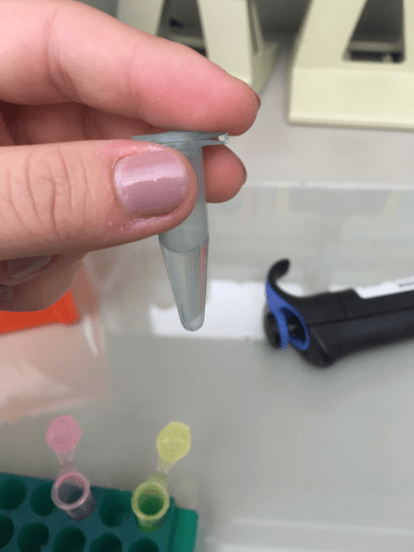
As someone who spends around 15 hours each week in a lab setting, I feel that one of the things I have come to understand very well is a standard laboratory procedure called the polymerase chain reaction, better known as PCR. To a non-scientist, and quite frankly also as a scientist, this sounds quite boring. However, this is one of the most non-boring things a person can do. PCR is one of the most vital lab practices to help humans understand ourselves, our history, and our relation to other organisms. Broken down into its simplest form, PCR is the copying of DNA. The scientist, in this case myself, will add genetic material and various other components to a test tube, put it in a machine that cycles necessary temperatures, and in a few short hours will have an exponential amount of copies of a specific gene contained in the DNA of whichever organism is being tested.
To go through the technical portion, DNA is what contains our hereditary information and it stores this in the form of genes. The genes in your DNA correspond to the traits you express and can help explain a lot of who you are, at least on a biological basis. When scientists are testing for a specific version of a gene, they cannot measure just the one gene from the DNA of one cell. Instead, they take that DNA and they make many many copies of the gene using PCR so they can see which version of the gene you have and continue many different types of studies from that point. PCR has helped us map the human genome, track our ancestors, cure various diseases, personalize medical treatment, determine paternity, and so much more.
For me personally, PCR isn’t just about the element of discovery. The first time I ever heard about this kind of science was in 6th grade when my history teacher had us watch an episode NOVA on PBS that covered the life and death of King Tut. They used PCR and various lab techniques to determine whether or not it was in fact King Tut who was mummified. I found this absolutely fascinating and it started my lifelong love of the NOVA program. It also was my first exposure to practical science. Growing up, I did not know any scientists, and very few of the doctors I knew were female. In high school, I was a part of a science research program, but many of my peers as well as my mentor were male. In college, I started to see more female representation in the science field. I joined a lab run by a female professor, then networked and used my newly acquired skills to get a job in stem cell research in a female investigator’s lab at Columbia. Much of what I did at this lab was PCR, and while on a day-to-day level it can get monotonous, the larger implications of this work are far-reaching.
I currently work in a lab here at Binghamton with many female peers, which I acknowledge is unusual. It feels empowering to be able to play such a large role in the scientific field, however, I almost never outwardly portray myself as a scientist. While lab is a huge part of my life, I never put it on any of my social media unless I am mocking or making a satirical comment about the time I am putting in. I believe this is something many students feel pressured to do, since a weekend in a lab is inherently less cool than a weekend abroad or out at bars or restaurants. Since my time at lab is not what most people my age find exciting, I tend to push it to the wayside and it is never a part of who I am when I portray myself online. This is one way in which my online portrayal of myself differs from who I identify as in reality, as we discussed in class.
While reading the Keller chapter, I related strongly to the discussion on how many young women do not identify as feminists even if they are guided by feminist values. Keller then goes on to discuss, within the context of feminist bloggers, the “click” moment and “going public”. The “click” is the realization that the girl is in fact a feminist and the “going public” portion is the sharing of this realization online. There are many factors that play into these moments, such as race, upbringing, education, and culture. Within my own personal life, I believe I fall within Keller’s initial description of how young women relate to feminism today; I agree with many feminist values and I consider myself a feminist, however, this is not something I shout from rooftops and bring up online or in day-to-day conversation.
I draw many parallels between being a woman in science and my personal identity within feminism. They are both parts of my values and large parts of my life, but also things I do not voluntarily share with others conversationally or online. While I have had a “click” moment in science, I have had more of a building understanding of where I land within the feminist community. I have not had “going public” moments for either of these identities. I also, as the chapter brings up, recognize my privilege in both of these facets. While I do not identify as scientist or a feminist online, I am certain I would face very little resistance if I did. I was raised in a Jewish household that believes strongly in the values of making the world a better place and supporting one another, I am caucasion, I am heterosexual, and I am currently pursuing a college education. It is interesting that even in this place of extreme privilege I still feel uncomfortable or unwilling to put these parts of myself on social media or other online conversational outlets.
References
Girls’ Feminist Blogging in a Postfeminist Age by Jessalynn Keller
 Science Student in a Cinema Class